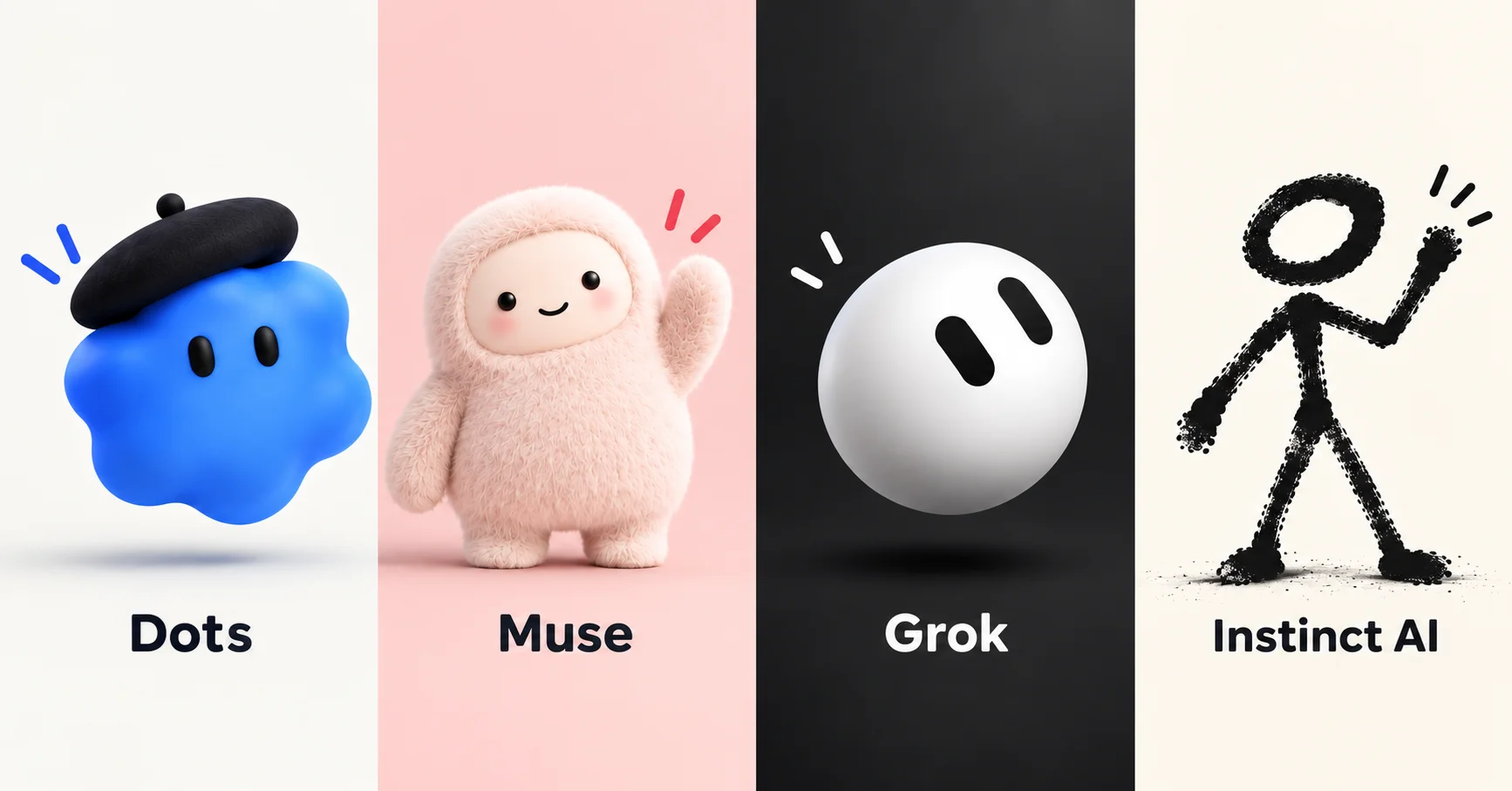



In seven weeks, three of the largest technology companies put personal AI agents in the hands of the public. xAI introduced Grok Bot on 11 August 2026. Meta unveiled Muse on 8 September. OpenAI announced Dots at DevDay on 29 September. Over the same summer, Instinct, an invite-only agent you simply text or call, spread by word of mouth.
They arrive with friendly faces, like the characters above. Behind the cartoons sits a serious change. These agents do not just answer questions: they open websites, read pages, compare offers, fill in forms and, with their user's approval, buy.
That changes who your website is built for. For twenty years, websites had two audiences: people and search engines. In 2026 they have four: people, search engines, AI answer engines such as ChatGPT, Gemini, Claude and Perplexity, and autonomous AI agents acting on behalf of a user.
In short: an AI-ready website is one that all four audiences can find, understand, cite and use. SEO remains the foundation. AEO, GEO and agent readiness are the layers that decide whether AI systems quote your business, recommend it and complete tasks with it.
This guide explains what changed, what an AI-ready website looks like, what agentic commerce means for online stores, and what to prepare now. It separates what is live today from what is still experimental.
What changed with AI agents in 2026?
AI agents moved from demos to consumer products. The new generation runs in the background on its own cloud computer, connects to its user's apps and acts on websites for them.
- Grok Bot (xAI, 11 August 2026, beta). Agents that run on their own cloud computer, sign in to the user's tools and handle multi-step tasks end to end. Several bots can work in parallel and escalate decisions that need human judgment.
- Muse (Meta, 8 September 2026, United States). Available on the web, iOS, Android and WhatsApp. It sends emails, books travel, fills in forms and makes purchases through Link by Stripe, with a free tier and paid plans at $20 and $100 a month.
- Dots (OpenAI, 29 September 2026). Always-on agents inside ChatGPT for Pro and Business Premium users. They pursue goals continuously and work across tools such as Slack and Microsoft Teams.
- Instinct (Spear Street Technology, summer 2026, invite-only). A personal agent reached by text message or phone call, which runs errands such as bookings, follow-ups and bill negotiations on a persistent cloud computer.
These products differ in tone and audience, but they share four traits:
- A goal, not a prompt. The user describes an outcome ("book a table for six near the office on Friday") and the agent plans the steps.
- A computer of its own. Muse, for example, works in a dedicated, isolated virtual machine with its own browser.
- Tools first, browser second. Muse connects through built-in connectors, then public APIs, and falls back on a browser when no API exists. Grok Bot follows the same logic with its plugins.
- Human approval for consequential actions. Paying, sending or publishing usually waits for the user's confirmation.
The third trait matters most for website owners. Agents prefer structured access. When a business offers none, the agent drives its website the way a person would, and every ambiguity on the page costs it time, accuracy or the sale.
What is an AI agent, and how is it different from a chatbot?
An AI agent is software built on a large language model (LLM) that receives a goal, plans the steps, uses tools such as a browser, an API or an app, and keeps acting until the goal is reached. It asks a human to approve sensitive actions such as a payment.
A chatbot answers within a conversation. An answer engine searches the web and returns a sourced answer. An agent goes one step further: it acts.
| Chatbot | AI answer engine | AI agent | |
|---|---|---|---|
| Starts from | A question | A question | A goal |
| Delivers | Text | An answer with sources | A completed task |
| Relation to your website | None, or a widget on it | Reads and cites it | Reads, navigates and acts on it |
| Examples | A support chatbot | ChatGPT search, Perplexity, Google AI Mode | Muse, Dots, Grok Bot, ChatGPT agent mode |
Agentic AI is the umbrella term for systems that pursue goals with this degree of autonomy. For a business, the practical consequence is simple: part of your audience is now software that has been given a job to do.
Which types of AI agents matter for businesses?
Four families of agents already interact with business websites. The first three visit your site. The fourth is one you can build.
- Personal agents. Muse, Dots, Grok Bot and Instinct run errands for one person: travel, bookings, purchases, administration. They reach businesses through connectors, APIs and websites.
- Browser agents. Since 21 October 2025, ChatGPT Atlas has included an agent mode that opens tabs and clicks through pages to complete a task, such as filling a grocery cart. It asks for permission before acting on sensitive sites.
- Answer and shopping engines. ChatGPT, Google AI Mode, Gemini, Microsoft Copilot and Perplexity research, compare and recommend. Some now also complete the purchase, as described in the e-commerce section below.
- Business agents. Agents a company deploys on its own channels. Since January 2026, Microsoft offers Brand Agents to Shopify merchants: an assistant trained on the brand's catalog that answers shoppers on the brand's own site. Internal agents connected to company data are another example, often through the Model Context Protocol (MCP).
For most companies, the urgent question is not "which agent should we use?" but "what happens when an agent visits us?"
Why do AI agents change the way websites must be built?
Because an agent does not experience a website the way a person does. It reads the page structure, the text and the data, and it acts through links, buttons and forms. Anything that is visual only, ambiguous or hidden behind scripts becomes friction.
The traffic is already measurable. According to Adobe, visits from AI sources to US retail sites rose 393% year over year in the first quarter of 2026. In March 2026, that traffic converted 42% better than non-AI traffic, when it converted 38% worse a year earlier.
The readiness gap is measurable too. In the same Adobe analysis, product pages scored 66% on machine readability, the lowest of all page types measured. Product pages are precisely where an agent decides whether to recommend or buy.
Platform owners now say so explicitly. Google's guide to generative AI search defines AI agents as systems that perform tasks on behalf of people, such as booking a reservation or comparing product specifications, and sends site owners to its agent-friendly website best practices: real <button> and <a> elements, labels linked to their inputs, no invisible overlays, a stable layout and a clean accessibility tree. OpenAI likewise advises site owners to add ARIA tags to improve how its agent interacts with their pages in Atlas.
The most common sources of friction are familiar to any technical SEO or accessibility specialist:
- key content, prices or stock rendered only by client-side JavaScript;
- information shown only in images, sliders or tooltips;
- icon-only buttons and custom dropdowns with no semantic meaning;
- form fields without labels, and error messages shown only in colour;
- pop-ups and interstitials that cover the content;
- shipping and return policies buried in PDFs;
- facts that contradict each other between the page, the structured data, the product feed and external profiles.
A person works around these problems. An agent may misread them, give up, or pick a competitor whose information is clearer.
From SEO to SEO + AEO + GEO + agent readiness
Agent readiness does not replace SEO. It adds layers on top of it. In its guide to generative AI search, last updated in July 2026, Google states that optimizing for generative AI search is "still SEO": there is no special markup or AI file to add, and a page must simply be indexed, eligible for a snippet and included in generative AI features in Search Console. A crawlable, indexable, well-structured site remains the base of everything.
| Layer | The question it answers | What it requires |
|---|---|---|
| SEO | Can search engines find, crawl and rank the page? | Crawlable HTML, indexation, speed, internal linking, relevant content |
| AEO (Answer Engine Optimization) | Can an engine extract a direct, correct answer? | Question-led headings, answer-first paragraphs, definitions, FAQs |
| GEO (Generative Engine Optimization) | Will generative engines cite and recommend the brand? | A clear entity, consistent facts across the web, third-party profiles, original evidence |
| Agent readiness | Can an AI agent complete a task reliably? | Structured data, feeds and APIs, accessible forms, explicit policies, verifiable trust |
Each era of the web added a discipline. Search engines made SEO a profession. Smartphones made mobile-first design the norm. Modern e-commerce made product data, payments and logistics part of the website itself. AI agents add a fourth requirement: the site must be usable by software, not only readable by it.
If you are new to the first two layers, our guide to AEO and GEO for AI search visibility explains what Google, OpenAI and Anthropic actually document about citations.
What does an "AI-ready website" actually mean?
An AI-ready website is a site whose content, data and actions can be found, understood, cited and used by machines as reliably as by people. In practice, it has seven properties.
1. The content lives in the HTML
The text, prices, specifications and policies that matter are present in the HTML the server returns, not only injected later by JavaScript. Not every crawler or agent executes scripts reliably, and the HTML is what all of them read first.
2. The architecture is answer-first
Each page covers one main topic. Headings are phrased as the questions people actually ask, and the first sentences under each heading give the answer before the detail. This is what lets an answer engine lift a passage and cite it accurately. We detail the method in Designing an Answer-First Page.
3. Structured data says the same thing as the page
Schema.org markup (Organization, WebSite, Service, Product, Offer, FAQPage, BreadcrumbList, Article) turns facts into data that machines parse without guessing. Google is explicit that no special schema is needed for its AI features, and that markup must match the visible text. Structured data is not a shortcut to AI visibility. It is a way to remove ambiguity.
4. The business is one consistent entity
Your name, address, services, founding date and key figures are identical on your site, your Google Business Profile, LinkedIn and the directories that describe you. sameAs links in your Organization markup connect these profiles to your domain. Generative engines cross-check sources, and contradictions weaken the signal.
5. The interface is actionable
Buttons are real buttons, links are real links, every form field has a label, and errors are explained in text. Flows are predictable and URLs are stable. Accessibility and agent readiness overlap almost completely: a site that works with a screen reader is much easier for an agent to operate. This is where UX/UI design becomes a technical discipline, not only a visual one.
6. Machines have their own entry points
An XML sitemap, a product feed, a documented API and, for complex services, an MCP server give agents a structured path instead of forcing them through the interface. An llms.txt file, proposed by Jeremy Howard in September 2024, can summarise a site for language models. Some tools read it, but it remains a proposal, and Google states that its Search does not use it.
7. Access is governed, not left to chance
Robots.txt reflects a deliberate choice for each crawler, for search and for model training. Bot protection distinguishes abusive automation from legitimate agents, which can now identify themselves cryptographically. Cloudflare introduced "signed agents" based on Web Bot Auth in August 2025, with ChatGPT agent among the first. Visa's Trusted Agent Protocol, launched in October 2025 with Cloudflare, applies the same idea to shopping agents.
Most of these properties are not new. What is new is that they now decide whether software can do business with you.
What does agentic commerce change for e-commerce?
Agentic commerce is the part of e-commerce where an AI agent researches, compares and sometimes purchases on behalf of a shopper. In October 2026, AI-led discovery is live at scale, while agent-led checkout is real but limited to some platforms and markets.
Discovery: the catalog becomes the storefront
When a shopper asks ChatGPT or Google AI Mode for "the best trail running shoes under €150", the answer is built from product data, not from your homepage design. On 24 March 2026, OpenAI announced that ChatGPT would focus on product discovery: merchants share their catalogs through the Agentic Commerce Protocol (ACP) or through partners such as Salesforce and Stripe, and Shopify merchants are included automatically. Google draws on Merchant Center feeds for AI Mode and Gemini.
The consequence: your product feed, your product page and your structured data must say exactly the same thing, and stay current.
Comparison: complete attributes win
Agents compare on structured attributes: price, total cost with shipping, delivery time, return window, size, compatibility, ratings. A product without a stated return window cannot be compared on returns. A price that differs between the feed and the page creates doubt. Completeness and consistency become ranking factors in practice, even where no platform calls them that.
Checkout: agents buy, merchants stay merchant of record
The major platforms took different paths, which is a sign of an immature market:
- Google announced the Universal Commerce Protocol (UCP) on 11 January 2026, co-developed with Shopify, Etsy, Wayfair, Target and Walmart. It enables checkout inside AI Mode and the Gemini app while the retailer remains the merchant of record. Merchants need a Merchant Center account and a product feed.
- Microsoft launched Copilot Checkout on 8 January 2026 in the United States, with PayPal, Shopify and Stripe.
- OpenAI went the other way. Instant Checkout, launched in September 2025, was discontinued in March 2026: purchases found in ChatGPT now complete on the merchant's own site.
For merchants, the lesson is not to bet on one assistant. It is to make the store work for all of them: clean data for discovery, and a checkout that a person or an agent can complete without friction.
Payments and trust: intent that machines can verify
When software pays, the merchant needs proof that the user really asked for it. Google's Agent Payments Protocol (AP2), announced on 16 September 2025 with more than 60 organisations, uses cryptographically signed "mandates": one for the user's intent, one for the exact cart and price. Visa's Trusted Agent Protocol helps merchants recognise legitimate agents. Most merchants will adopt these through their payment provider rather than build them.
Machine to machine: when the agent never sees your page
The Model Context Protocol (MCP), created by Anthropic, is an open standard that connects AI applications to external tools and data. In December 2025 it was donated to the Agentic AI Foundation under the Linux Foundation, with more than 10,000 active public servers and support in ChatGPT, Gemini, Microsoft Copilot and Visual Studio Code. On the browser side, Chrome opened an origin trial for WebMCP in Chrome 149 in June 2026, letting a site declare its own tools to in-browser agents. WebMCP is experimental, but it shows where the web is heading: sites that tell agents what they can do, instead of letting them guess.
Where each technology stands in October 2026
| Technology | Led by | What it does | Status |
|---|---|---|---|
| Schema.org structured data | Schema.org community | Describes organisations, products, offers, policies | Established standard |
| Product feeds for AI engines (ACP, Merchant Center) | OpenAI, Google | Puts catalogs into AI shopping answers | Live |
| Model Context Protocol (MCP) | Agentic AI Foundation (Linux Foundation) | Connects AI apps to tools and data | Widely adopted |
| Universal Commerce Protocol (UCP) | Google, with Shopify, Etsy, Wayfair, Target, Walmart | Checkout inside AI Mode and Gemini | Rolling out |
| Copilot Checkout | Microsoft | Checkout inside Copilot | Live in the United States |
| Agent Payments Protocol (AP2) | Google and 60+ partners | Proves the user authorised a payment | Open spec, early adoption |
| Web Bot Auth, Trusted Agent Protocol | Cloudflare, Visa | Lets legitimate agents identify themselves | Early adoption |
| WebMCP | Google Chrome | Lets sites declare tools for browser agents | Experimental (origin trial) |
| llms.txt | Community proposal | Summarises a site for language models | Proposal, not used by Google |
None of these is a universal standard for the whole web yet. Treat the bottom half of the table as signals to follow, not as boxes to tick.
Is your website ready for AI agents? A 20-point checklist
Use this list to assess your site in an hour. Each "no" is a concrete task. For a faster, tool-based version focused on citations, see How to Audit a Client Site for AI Visibility in 30 Minutes.
Can machines find and read it?
- Your key pages are indexed in Google and Bing.
- The main content, prices and specifications appear in the HTML source, without running JavaScript.
- Robots.txt reflects a deliberate decision for each AI crawler, for search and for training.
- Your XML sitemap is complete and up to date.
Can they understand it?
- Each page answers one main question, stated in its H1 or first H2.
- The first sentences under each heading give the answer.
- Organization, WebSite and page-level Schema.org markup is valid and matches the visible content.
- Your company facts are identical on your site and on every external profile.
Can they cite it?
sameAslinks connect your domain to your official profiles.- Your pages contain original, verifiable evidence: data, methods, worked examples.
- Authors and update dates are visible.
Can they act on it?
- Buttons and links are real HTML elements with clear text labels.
- Every form field has a label, and errors are explained in text.
- Key journeys work without pop-ups covering the content.
- Your bot protection does not block identified, legitimate agents by default.
Can they buy from it? (e-commerce)
- Product markup includes price, currency, availability, brand and GTIN or SKU.
- Shipping and return policies exist as HTML pages and in structured data, ideally defined once at Organization level.
- The product feed, the product page and the markup show the same price and stock.
- Guest checkout is available and the total cost is visible before payment.
- You have reviewed what your platform offers for AI channels: Shopify Catalog, Google Merchant Center, an ACP feed for ChatGPT.
Fifteen or more "yes" answers is a solid base. Fewer than ten means AI systems are likely to describe your business with gaps, or to leave it out.
What should businesses prepare now?
The right plan separates what is proven from what is still being decided. A reasonable sequence looks like this.
Now: what already pays off
- Fix rendering and technical SEO, so every important page is crawlable and fast.
- Restructure key pages answer-first, starting with services, products and FAQs.
- Implement and validate structured data across the site.
- Align your entity everywhere: website, Google Business Profile, LinkedIn, directories.
- Track AI referrals in your analytics, with a dedicated channel for ChatGPT, Perplexity, Gemini, Claude and Copilot.
Next six months: what is being adopted
- Publish complete, synchronised product feeds to Google Merchant Center and to ChatGPT.
- Review your platform's agentic options. Shopify, for example, already connects merchants to ChatGPT, Copilot and UCP.
- Audit checkout and forms for accessibility, which serves agents and people with disabilities alike.
- Define a bot policy with your CDN or security provider instead of blocking all automation.
Watch: what is still emerging
- WebMCP, for sites that want to declare tools to browser agents.
- Agent payment protocols such as AP2 and the Trusted Agent Protocol, through your payment provider.
- An MCP server or a public API, if your offer involves quotes, bookings or configuration.
llms.txt, as a cheap complement, not a priority.
This is a reasonable anticipation, not a certainty. The protocols will consolidate, some will disappear, and others will appear. The fundamentals in the first block will matter whichever ones win.
Conclusion: build for the four audiences
Your website may work perfectly for people and for Google today. The question for 2027 is whether it also works for the software that increasingly researches, compares and buys on your customers' behalf. The friendly faces of Muse, Dots, Grok Bot and Instinct make that change easy to underestimate. It is a change in how the web is used, and therefore in how it must be built.
The good news is that agent readiness rewards quality work: clean HTML, clear content, exact data, accessible interfaces and consistent facts. These are the same qualities that already serve your visitors and your search rankings.
At Genesis Digital Factory, we have been building and running websites since 2005, with more than 85,000 projects delivered for agencies and companies across Europe. Our teams combine the disciplines this shift requires: website production on WordPress and Webflow, e-commerce on Shopify and PrestaShop, UX/UI design, technical SEO and structured data, Answer Engine Optimization, Generative Engine Optimization, and AI integration through APIs and automation. Agencies can also rely on us in white label to deliver this work under their own brand.
If you want to know how your website or online store looks to an AI agent, send us its URL. We will assess it against the four audiences (people, search engines, answer engines and AI agents) and send you a written list of priorities.
Common questions
What is an AI agent?
An AI agent is software built on a large language model that receives a goal, plans the steps and uses tools such as a browser, an API or an app to reach it. Unlike a chatbot, it acts: it can navigate websites, fill in forms and, with its user's approval, make purchases.
What is an AI-ready website?
An AI-ready website is a site whose content, data and actions can be found, understood, cited and used by machines as reliably as by people. It combines technical SEO, answer-first content, structured data that matches the page, a consistent business entity across the web, accessible interfaces and machine entry points such as feeds or APIs.
What is the difference between AEO and GEO?
Answer Engine Optimization (AEO) makes a page easy to extract as a direct answer, through question-led headings and answer-first paragraphs. Generative Engine Optimization (GEO) increases the chance that generative engines such as ChatGPT, Gemini, Claude and Perplexity cite and recommend a brand, through entity clarity, consistent facts and credible third-party sources. Both build on SEO.
Does Google require special markup to appear in AI Overviews or AI Mode?
No. Google states that optimizing for generative AI search is still SEO, with no special Schema.org markup or AI file to add. A page must be indexed, eligible for a snippet and included in generative AI features in Search Console, and any structured data should match the visible content.
Do I need an llms.txt file?
It is optional. llms.txt is a proposal published in September 2024 to summarise a site for language models. Google states that its Search does not use it, and no major assistant documents it as a citation input. It costs little to add, but it should come after technical SEO, content structure and structured data.
Can AI agents already buy from my online store?
It depends on your platform and market. Google's Universal Commerce Protocol enables checkout in AI Mode and Gemini, and Microsoft Copilot Checkout is live in the United States. Since March 2026, purchases started in ChatGPT complete on the merchant's own site. In every case, complete product data and a frictionless checkout are prerequisites.
What is agentic commerce?
Agentic commerce is e-commerce in which an AI agent researches, compares and sometimes purchases on behalf of a shopper. It relies on structured product data, product feeds, payment protocols such as Google's AP2, and ways for merchants to verify that an agent acts for a real customer.
How can I tell whether AI systems visit my website?
Check referrals from chatgpt.com, perplexity.ai, gemini.google.com, claude.ai and copilot in your analytics, ideally grouped in a dedicated channel. Server logs show AI crawlers by user agent, and providers such as Cloudflare now classify signed agents separately from other bots.
Is WordPress, Webflow or Shopify better for AI readiness?
All three can produce an AI-ready site. What matters is the implementation: clean server-rendered HTML, structured data, performance, accessible forms and synchronised product data. Our WordPress vs Webflow vs Framer comparison covers the trade-offs for SMEs.
Sources & Further Reading
All sources consulted on 2 October 2026.
- xAI, "Introducing Grok Bot", 11 August 2026
- TechCrunch, "Meta debuts its Muse AI agent. Will consumers trust it?", 8 September 2026
- TechCrunch, "OpenAI launches Dots, its bubbly agentic avatar", 29 September 2026
- Vellum, "Official Instinct Breakdown (2026)"
- OpenAI, "Introducing ChatGPT Atlas", 21 October 2025
- OpenAI, "Powering product discovery in ChatGPT", 24 March 2026
- OpenAI, "Agentic Commerce Protocol" documentation
- Google, Sundar Pichai's remarks at NRF 2026, 11 January 2026
- Google for Developers, "Getting started with Universal Commerce Protocol on Google"
- Google Cloud, "Announcing Agent Payments Protocol (AP2)", 16 September 2025
- Google Search Central, "Optimizing your website for generative AI features on Google Search"
- Google Search Central, "AI features and your website"
- Google Search Central, "Merchant listing structured data"
- web.dev, "Build agent-friendly websites", April 2026
- Microsoft, "Microsoft propels retail forward with agentic AI capabilities", 8 January 2026
- Anthropic, "Donating the Model Context Protocol and establishing the Agentic AI Foundation", 9 December 2025
- Chrome for Developers, "Join the WebMCP origin trial", 9 June 2026
- Cloudflare, "The age of agents: cryptographically recognizing agent traffic", 28 August 2025
- Visa, "Visa Introduces Trusted Agent Protocol", 14 October 2025
- Adobe, "AI traffic grows but retail sites lag in AI search visibility", 16 April 2026
- llmstxt.org, "The /llms.txt file"